Founders, investors, and the TAM question
The first question most investors ask about a new product is the size of the market. Their job is to put money somewhere it can grow into something much larger, and the math has to work before the bet does. TAM is the right tool for what they're doing.Total addressable market - the revenue available if every customer who could plausibly buy did. It's a ceiling, and it gets treated as a forecast more often than it should.
When I'm sitting at the start of building something, it isn't the question I'm trying to answer. I want to know if the thing is real, if it solves something I care about, if I'd keep using it years from now. Market size sits at a different layer. Founders and investors are doing different jobs that happen to look similar from a distance.
A founder has to be optimistic in a way an investor can't afford to be. To start something you have to believe it can exist, even when most of the evidence says it won't. If you waited for proof, like an investor does, you'd never begin. The investor's job is to protect the downside, find asymmetric bets, avoid the bad ending. Both can produce great things, but the orientation is different, and so the thinking and approach are different.
Buffett and Munger on Musk is a useful example. They've never been in awe of what he does. Munger has more or less said Musk is part genius, part lucky, and part willing to take the kind of risks that should have killed him a few times over. He's also said he prefers people who underestimate their own IQ to people who overestimate it, and Musk in his view sits firmly in the second camp. Tesla and SpaceX both came close to ending in 2008. He doubled down anyway, and from Munger's seat, that's not an investable strategy. From Musk's seat, it was the only move he had.
The IQ comment is the same divide in another shape. An investor wants to back people who won't bet the company on their own brilliance, because ego does more damage to capital than ignorance. A founder probably needs the opposite, or close to it. Someone who accurately estimates the difficulty of what they're trying to do, and their own odds of pulling it off, usually doesn't start. Overestimating yourself looks like a flaw from the investor's seat and a cost of admission from the founder's.
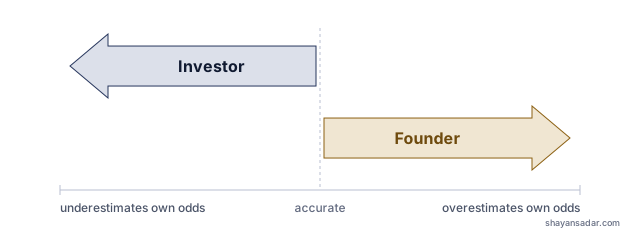
I don't think Munger is wrong. Plenty of founders did the same thing and didn't make it out. We only hear about Musk because he survived. Munger is right that it wasn't a sound investment. Musk is right that it was worth doing. They were never trying to do the same thing.
This is where TAM fits in for me. It's an investor's tool, asking an investor's question. When it gets applied to someone at the start of building, it's asking the wrong question of the wrong person. The founder doesn't yet know how big the thing can be, and often the most interesting things start with no defensible TAM at all. Facebook, YouTube, Spotify, Shopify all looked too small or too late or too crowded at the start.Each of them was partly building the market it went on to measure. At the time of the estimate, there was nothing to price. The market they ended up in didn't fully exist yet.
TAM matters more the further you get from the beginning. Early on, the real question is whether the thing is worth building, and that's something the founder has to answer for themselves.