Do you own ADRs in your portfolio?
An ADR is a receipt where a bank holds shares somewhere and issues you a piece of paper that tracks them.An American depositary receipt is the certificate issued by the depositary bank. An American depositary share is the individual unit that trades. One ADR can represent one ADS, several ADS, or a fraction of one. Buy Apple and you own a piece of Apple.
Buy Alibaba's ADS and you own a receipt from Citibank against ordinary shares in a Cayman Islands holding company. That company owns some PRC subsidiaries and controls parts of the Chinese business through contracts where foreign ownership is restricted. Its filings say those contractual arrangements have not been tested in a PRC court and their enforceability is uncertain.
Alibaba, PDD, JD and Baidu all use Cayman holding-company and ADS structures, with VIE arrangements for restricted Chinese businesses.
In October 2022 the Magnificent Seven were beaten down by a year of rate hikes, and so were these four Chinese names, beaten down by a regulatory crackdown that had already killed Ant Group's IPO and cost Alibaba a $2.8 billion antitrust fine. Nearly four years later, $100 in Meta became about $400 and the same investment in Google more than $300. The four Chinese names sit close to where they started, with a couple of sharp rallies in between that mostly gave themselves back.
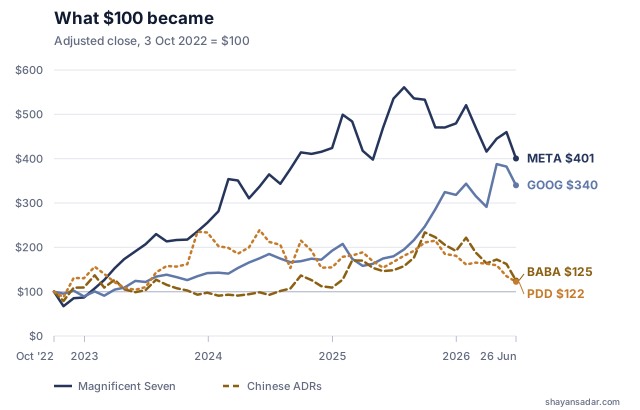
PDD's revenue went from 130 billion yuan in 2022 to 432 billion in 2025.At the chart's endpoints, US$1 bought RMB7.1103 on 3 October 2022 and RMB6.7980 on 26 June 2026, using the Federal Reserve's daily H.10 rate. Alibaba's net income rose 77% in fiscal 2025. These are companies still doing exactly what they're supposed to do and yet the market simply decided to pay less for every yuan of profit they produce, and it has kept deciding that for four years running.
China's crackdown erased trillions in value between 2020 and 2022 and taught a generation of investors that policy can turn overnight. The 2022 audit agreement gave the PCAOBThe Public Company Accounting Oversight Board is the US watchdog that inspects the auditors of public companies. access after years of standoff, but the PCAOB says it will reconsider its determination if that access is obstructed. None of the four Chinese companies sit in the S&P 500, so they do not receive its index-fund buying. And the Chinese domestic economy has been genuinely weak through much of this stretch: a property downturn, bouts of deflation since 2023, and elevated youth unemployment.
A price shaped by the 2021-22 crackdown is still in the price in 2026. The fear has outlasted the facts that caused it. A value trap and a mispriced stock look identical on a screener. Which bet did you make nearly four years ago, and are you still holding on?